
Is a Currency Conversion Cost the Same as a Payment Processing Fee?
Introduction
A cross-border payment can involve several costs, and receipt or statement labels don’t always make them easy to tell apart. Currency conversion and payment processing can both add to the amount paid, but they cover different services: one exchanges currencies; the other handles the payment.
The distinction matters because a payment may be processed in one currency and converted later, or the merchant may offer to convert the price at checkout. Each option can involve different providers, rates and disclosures. Treating every extra amount as a generic transaction fee makes it harder to understand the costs and compare options.
Who pays for what?
If a cardholder pays in a currency different from the one used for their account, the amount must be converted somewhere in the payment chain. The exchange rate may be set by a card network, card issuer, payment provider or the merchant’s conversion service. The details depend on the transaction and the service terms.
The cost of conversion may be built into the exchange rate, charged separately as a foreign-transaction fee, or include both. A rate can contain a margin, while a separate fee is an additional charge from an issuer or provider. The word “conversion” does not refer to one standard fee.
Payment processing is a separate service. It covers transmitting payment details, requesting authorization, routing the transaction and arranging settlement. Merchants typically pay a processor or acquiring provider for these services, often through a pricing structure with several components. This cost does not become a currency-conversion charge just because the customer is abroad.
Several parties may be involved. An issuer may charge the cardholder, a network may set rules or rates, and a conversion provider may apply its own terms. The party that pays a charge, the party that collects it and the party that ultimately keeps it may be different.
A higher price for a particular currency or payment method can reflect a disclosed surcharge, a conversion margin, the merchant’s processing costs or a combination of these. The label alone does not show which service the charge covers.
Key factors
Where conversion takes place. At checkout, a cardholder may be asked to pay in the local currency or the currency of their account. If they choose the local currency, conversion generally happens later in the payment chain. If they choose their account currency, the merchant or its conversion provider may set the displayed amount. The choice affects who supplies the rate, not whether the payment still needs to be processed.
The exchange rate and its margin. A conversion cost may be included in the exchange rate rather than shown as a separate fee. The customer could therefore pay more than they would at a reference rate without seeing an additional line on the statement. To compare costs, look at the total amount and the rate used, not just the fee labels.
Separate charges and different payers. A card issuer’s foreign-transaction fee, if there is one, is distinct from the merchant’s processing bill. The issuer may charge the cardholder under the account terms; the merchant generally pays for accepting the transaction. A merchant may reflect its business costs in its prices, but that does not make payment processing a currency exchange service.
Disclosure and timing. The amount shown at checkout may differ from the final settled amount if the exchange rate is set later in the process. The timing and rules vary, so a displayed estimate is not necessarily a guaranteed final amount. Check the terms to see what applies.
What the receipt says. A statement may show the purchase amount, a converted amount and a separate fee without explaining every party’s role. To understand the costs, ask: Which currency did the merchant charge? Who converted the amount, and at what rate? Was a separate fee added, and under whose terms? These details help distinguish the cost of exchanging currency from the cost of handling the payment.
Scenario: One purchase, two different costs
Suppose a customer with a euro-denominated account buys an item priced in another currency. The merchant submits the transaction for processing, which covers authorization and settlement. If the transaction stays in the merchant’s currency, another party may later convert it into euros. The rate may include a conversion margin, and the issuer may charge a separate fee.
Now suppose checkout offers to charge the customer directly in euros. The merchant’s conversion provider may set the price shown. The payment still needs to be authorized and settled; the customer has changed the conversion route and the source of the rate, not removed the processing step.
In either case, the final cost may exceed the item’s listed price for different reasons. There may be a conversion margin, a fee under the cardholder’s account terms, and a separate processing cost paid by the merchant. These costs affect the economics of the sale, but they cover different services and may be paid by different parties.
Customers should compare the full amounts: the displayed converted price against the likely cost of paying in the merchant’s currency, including any applicable issuer fee. Merchants, meanwhile, should distinguish their processor charges from any costs or revenue associated with offering currency conversion.
Conclusion
A currency conversion cost is not the same as a payment processing fee. Conversion changes one currency into another and may involve a rate margin or a separate charge. Processing handles authorization, routing and settlement. A cross-border purchase can involve both, but they serve different purposes and may involve different providers and payers.
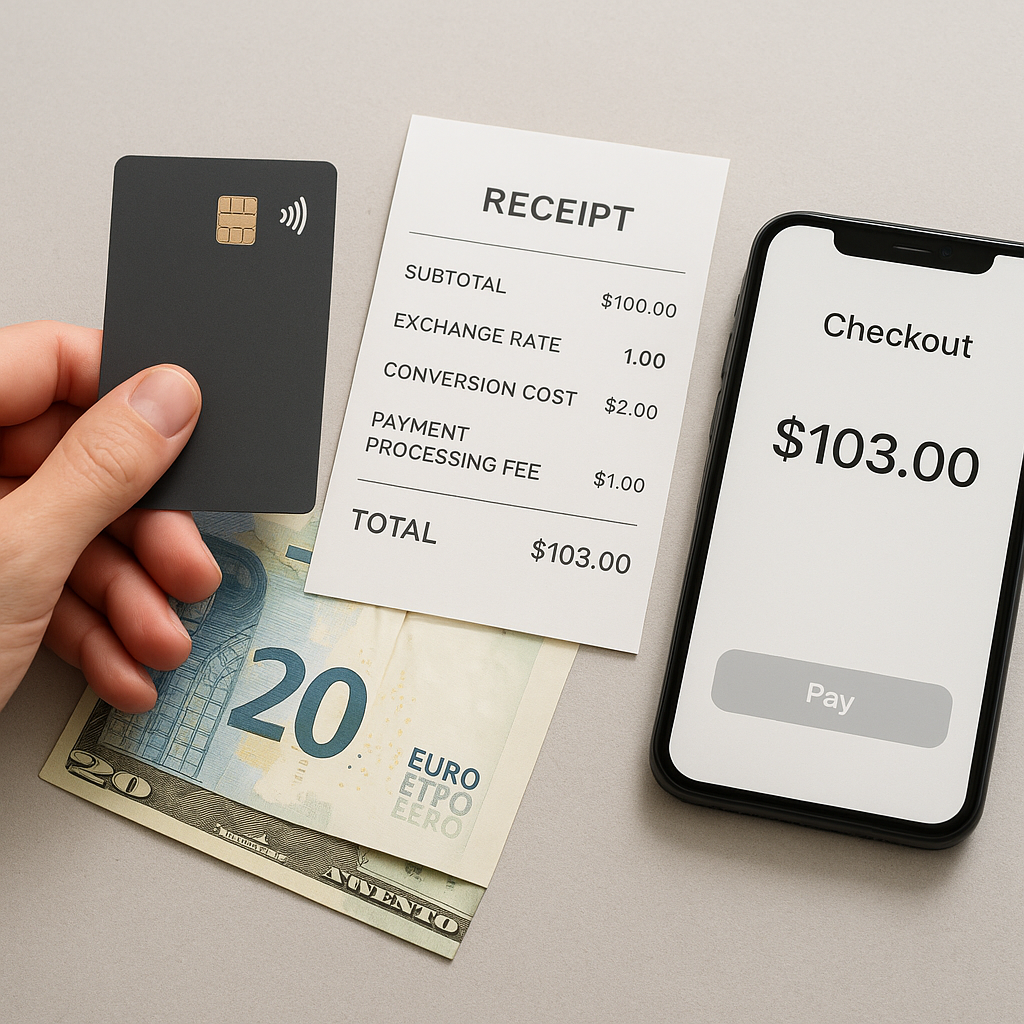
To understand the transaction, identify the currency charged, where and at what rate it was converted, whether a separate fee was added, and who was responsible for it. This is more useful than treating every extra cost as a generic card fee—and shows what the customer paid for and what the merchant paid to accept the sale.